Author
Logan Johnson
Evidence
Published specs, catalog receipts, owner-reported failure patterns
Policy
No sponsored placementsAt a Glance
Best For
Overview
The Weller WE1010NA sits in an odd spot in the market: it's cheaper than the Hakko FX-888D, has 70W versus Hakko's 65W, but most hobbyist recommendation threads still give the nod to Hakko. The reason is temperature stability — ±5°C versus ±2°C under load. For casual use, that gap is invisible. For precision work, it matters.
That said, the WE1010NA isn't a bad station. It's a different trade-off. The extra 5W of headroom translates to noticeably faster recovery on larger thermal-mass joints — soldering a heavy ground lug, a chassis grounding point, or 12-gauge wire through a connector. The FX-888D can feel sluggish on those joints. The Weller doesn't.
The WE1010NA's natural buyer is someone who does more mixed electrical/electronics work than pure PCB assembly — a technician who solders wire harnesses one day and PCBs the next. For that use case, the Weller's 70W and wide tip ecosystem (including legacy WES51 compatibility) makes it the more practical choice. If your work is exclusively PCB assembly and component-level repair, the FX-888D's tighter stability justifies the modest price difference.
Pros & Cons
Pros
- 70W gives noticeably better heat recovery on large joints than 60W Hakko
- Iron heats from cold to 400°C in under 20 seconds
- ETA tip series is affordable and widely available at hardware stores
- Large easy-to-read display with lock function
- Compatible with Weller's older WES51 tips — huge legacy ecosystem
- Often $10–20 cheaper than FX-888D
Cons
- Temperature stability slightly looser than Hakko (~±5°C vs ±2°C under load)
- Iron cable is stiffer and heavier than Hakko's
- No programmer presets — single temperature display only
- Holder design collects flux residue and is harder to clean
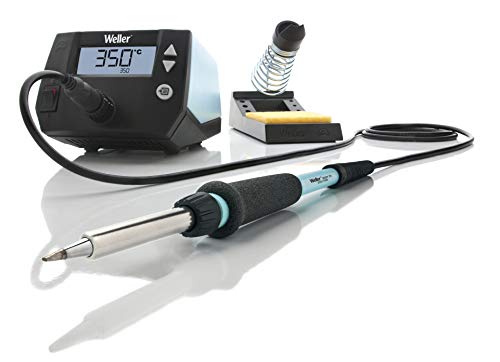
Weller WE1010NA Digital Soldering Station
Prices may change · Free shipping with Prime
70W vs 65W — When the Extra Wattage Actually Matters
Wattage gets over-discussed in soldering station comparisons. For most bench work — SMD assembly, through-hole PCB, small component replacement — the difference between 60W, 65W, and 70W is invisible. A modern soldering station can idle at whatever temperature you set regardless of wattage; wattage determines how quickly it recovers from thermal load.
The WE1010NA's 70W advantage shows up in three specific scenarios. First: soldering to copper planes. A 2oz copper ground plane absorbs heat faster than most station tips can deliver it. The FX-888D requires raising the setpoint temperature (320°C→ 370°C on leaded) or slowing down significantly to let heat transfer. The WE1010NA, with its extra headroom, holds the setpoint temperature longer before sagging.
Second: large wire connections. Soldering 14 or 12 AWG wire into a terminal block, or doing automotive electrical repair where you're bonding thick stranded wire, puts thermal demand on the tip that lighter gauge PCB work doesn't. The Weller handles this at standard temperatures; the Hakko may require bumping up 20°C.
Third: fast-paced repetitive assembly. If you're hand-soldering 50+ joints continuously, the WE1010NA's faster recovery means shorter pause between joints. For occasional hobby use this is unnoticeable. For a repair tech working all day, the pace difference accumulates.
None of these are reasons to pick the Weller over the Hakko if your primary use is small-component SMD work. But if your typical session involves a mix of work including heavier joints, the Weller's thermal margin is a real advantage.
Temperature Stability — Honest Comparison to Hakko
The ±5°C stability spec for the WE1010NA versus ±2°C for the FX-888D is the most frequently cited difference between them, and it deserves honest analysis rather than headline repetition.
At the bench, ±5°C means the tip temperature fluctuates within a 10°C band centered on your setpoint. Set 315°C, and you might see 310–320°C. For leaded solder work — anything from through-hole assembly to consumer electronics repair — this is within acceptable range. Joints come out fine. Components don't get damaged. The difference is rarely visible in the quality of finished work.
Where ±5°C becomes tangible: fine-pitch SMD work under magnification, temperature-sensitive components (certain MLCCs, flex connector contacts, precision resistors), and work where you're already soldering at the margin (thin PCB traces that can delaminate at 350°C+). In those scenarios, the FX-888D's tighter stability gives you more working room between 'good joint' and 'damaged component'.
Practical verdict: if you're not regularly doing 0402 SMD work or repairing components that fail at 330°C, the stability difference between these stations doesn't decide the outcome of your solder joints. The technique variable — how long you dwell, how much flux you use, how cleanly you pre-tin — swamps the 3°C thermal stability advantage in typical use.
The ET Tip Ecosystem and Legacy WES51 Compatibility
Weller's ET series tips have their own depth. The lineup covers standard conical (ETB), fine conical (ETP), small chisel (ETD), large chisel (ETH), bevel (ETJ), and specialty shapes. The selection isn't quite as wide as Hakko's T18 library, but it covers all common use cases.
The significant advantage for specific buyers: the WE1010NA is backward-compatible with tips from the WES51/WESD51, which was the previous generation workhorse station in professional settings. If you're a repair shop upgrading from WES51 stations, your existing tip inventory transfers over. For a new buyer starting fresh, this is irrelevant — both T18 and ET tips are readily available online at comparable prices.
Third-party ET-compatible tips are available but less prolifically manufactured than T18 alternatives. Hakko's T18 tips have been cloned by Chinese manufacturers for 15+ years and are available for $2–4 at volume. Weller ET clones exist but the selection and quality consistency is narrower. For someone who goes through tips quickly (production use, lots of lead-free soldering), the T18 ecosystem's replacement availability is a practical win for Hakko.
One quirk: the WE1010NA ships with the ETB tip (small bevel), which is reasonable for through-hole but not for SMD. Add an ETD (small chisel) if you're doing component-level PCB work. Same recommendation as the Hakko: don't start SMD work with the included tip.
What the WE1010NA Does Better Than Hakko (and What It Doesn't)
The WE1010NA wins in three categories. Heat delivery on demanding joints — addressed in the 70W section above. Warm-up speed: the WE1010NA heats from cold to 400°C in under 20 seconds; the FX-888D takes 30+ seconds. In a workflow where you fire up the station for a quick five-minute repair and then shut it down, those 10 seconds register.
The third win is ergonomics at the macro level. The WE1010NA's display is slightly larger and easier to read from across the bench. The temperature lock function (prevents accidental setpoint changes) is accessible and functional.
The FX-888D wins in tip stability under load, tip ecosystem breadth, and the programming preset feature (5 stored temperatures versus none on the WE1010NA). The preset feature is underrated for a bench that runs multiple solder types — leaded assembly at 315°C, lead-free paste at 360°C, and chip-quik at 200°C can be recalled instantly instead of dialing in each time.
The iron cable is a legitimate gripe for the WE1010NA: it's stiffer and heavier than Hakko's, and it creates more wrist resistance during long sessions. This is a comfort issue that doesn't affect output quality but annoys during extended use. The holder design is also harder to clean — flux residue accumulates in the coil holder and requires regular maintenance.
The Right Buyer for the WE1010NA
The WE1010NA makes most sense for three specific buyer profiles. First: the multi-discipline electronics technician who does PCB work and heavier electrical assembly in the same sessions. The 70W advantage pays for itself on those heavier joints, and the stability gap doesn't hurt on the PCB side enough to matter.
Second: the shop upgrading from WES51 stations. Tip inventory carries over, which has real cost value. The training muscle memory on Weller controls transfers. There's no reason to switch to Hakko purely for the migration.
Third: buyers who find the FX-888D out of stock or locally unavailable. The WE1010NA is the closest direct alternative — it's not a compromise pick, it's a different trade-off at the same tier.
For a pure PCB assembly or component-repair hobby use case with no heavy wire work, the FX-888D at a similar or sometimes lower price is the recommendation. But the narrative that the WE1010NA is 'worse' than the Hakko is too simple — it's better in some real scenarios and slightly behind in others. Honest advice: if you regularly solder anything heavier than 18 AWG wire, look seriously at the Weller. If your world is exclusively PCB pads and SMD components, the Hakko's tighter stability is worth the same money.
Our Verdict
The WE1010NA trades Hakko's precision for raw wattage and lower entry cost. For beginners and hobbyists who solder intermittently, it's excellent. Professionals who care about tight temp stability should step up to FX-888D or better.
Weller WE1010NA Digital Soldering Station
$115
Prices may change · Free shipping with Prime
| Full Specifications | |
|---|---|
| Station Type | Digital Soldering Station |
| Wattage | 70W |
| Temp Range | 200–450°C |
| Temp Stability | 5±°C |
| Tip System | ET Series |
| Digital Display | Yes |
| Temp Lock | Yes |
| Sleep Mode | Yes |
| Hot-Air Channel | No |
| Channels | 1 |
| Unit Weight | 2.5lbs |
Frequently Asked Questions
Can the WE1010NA use Weller WES51 or WES50 tips?
Is the WE1010NA good enough for fine-pitch SMD work?
How does warm-up time compare to the Hakko FX-888D?
Does the WE1010NA have programmable temperature presets like the Hakko FX-888D?
Related Buying Guides
Compare With Similar Bench Tools
Head-to-Head Comparisons
Weller WE1010NA Digital Soldering Station
$115
Prices may change · Free shipping with Prime