Author
Logan Johnson
Evidence
Published specs, catalog receipts, owner-reported failure patterns
Policy
No sponsored placementsAt a Glance
Best For
Overview
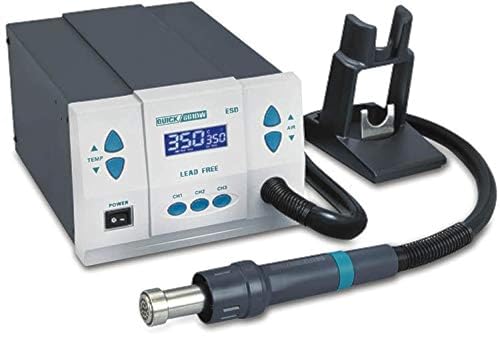
The Quick 861DW is the hot-air rework station that comes up in every 'what should I buy for SMD rework' thread where the answer isn't the $400 Hakko FR-811 or an obscure direct-from-China unit with no documentation. At $119, it fills a gap: competent hot-air for real SMD work without the pricing of professional-grade equipment or the unreliability of the cheapest tier.
Hot air is the process that enables work a soldering iron cannot do. Removing BGA chips, reflowing QFN packages, lifting SMD components without pad damage, reflowing solder paste on stencil-applied boards — all of these require controlled hot air. A $20 heat gun from a hardware store does none of them. It blows too much air, has no fine temperature control, and scatters small components across the bench. A real hot-air rework station delivers calibrated airflow and temperature with interchangeable nozzles for different component footprints.
The Quick 861DW delivers stable airflow at the low end — the critical spec for fine SMD work — with a 700W heater that recovers quickly and nozzle geometry choices that cover most common scenarios. It's not the station for a volume production environment. It's the station for a bench where hot-air is one of several tools, used when iron-only technique isn't sufficient.
Pros & Cons
Pros
- Stable airflow at low settings — critical for fine SMD rework without blowing components
- 700W heater recovers quickly after opening the gun nozzle
- Wide temperature range covers both low-temp paste and lead-free rework
- Includes 5 nozzle shapes for different component footprints
- Automatic sleep when handpiece holstered — extends element life
- Better-built than YIHUA/ATTEN alternatives in the same price band
Cons
- Display calibration can drift — verify with thermocouple on first use
- No iron channel — hot-air only, needs a separate soldering station
- Pump noise is audible in quiet environments
- Nozzle set is not labeled — requires reference card to identify shapes
Quick 861DW Hot Air Rework Station
Prices may change · Free shipping with Prime
Airflow Stability at Low Settings — The Most Important Spec You Never See Advertised
Hot-air station specs are dominated by temperature range and wattage. The spec that actually matters most for fine SMD rework is airflow stability at low volume settings — and it's rarely listed on the product page.
Here's why it matters: removing a small SMD component (0402, 0603, SOT-23) requires bringing the component and its pads to reflow temperature while disturbing surrounding components as little as possible. The only way to do that is to deliver hot air precisely and gently. Too much airflow blows the target component off the board. Too much airflow blows the 0402 next to it off the board. The skill of hot-air rework is mostly about airflow control at the low end of the dial.
Cheap hot-air stations have turbulent, inconsistent airflow at low settings — the airflow stutters, surges, and doesn't hold a steady volume. The Quick 861DW holds steady laminar airflow down to its minimum setting without stutter. This is observable by holding the handpiece over a small piece of tissue paper: it flutters consistently rather than jerking erratically.
In practice, for removing 0402 components: hold the nozzle 1–2cm above the target, set airflow to 2–3 on the dial (out of 8), set temperature to 340–360°C for leaded solder, and move in slow circles over the component until it releases. The Quick 861DW holds its airflow steadily enough for this technique to work reliably. Budget stations with turbulent low-end airflow make this technique unrepeatable.
Working Temperatures and Calibration — What to Verify on First Use
The Quick 861DW's temperature dial runs from 100°C to 480°C. For most reflow work, you'll operate between 300°C and 380°C — lower for leaded solder (183°C liquidus, work temperature 330–350°C), higher for lead-free SAC305 (217°C liquidus, work temperature 360–380°C). The station displays setpoint temperature, not actual tip temperature.
Here's the important caveat: the calibration from the factory drifts. Hot-air stations in this price class are notorious for a 20–40°C gap between displayed and actual tip temperature at the nozzle. The Quick 861DW is better-calibrated than most alternatives in its price range, but 'better' doesn't mean 'exact'. On first use, verify the actual air temperature with a K-type thermocouple probe (the kind that comes with many handheld multimeters including some Uni-T models). Hold the thermocouple in the airstream at the nozzle exit and compare to the display.
If your station shows a 30°C discrepancy, compensate consistently — set 370°C when you want 340°C — and you'll get reliable results. If the discrepancy is larger than 50°C, calibrate using the station's internal adjustment (there's a trimmer accessible after opening the case on some units) or work around it with systematic correction.
For most bench work, the practical approach is to use the thermocouple verification as a reference calibration once, note the offset, and apply it consistently. The station's repeatability — getting the same actual temperature from the same displayed setting every time — is more important for production use than absolute accuracy.
Nozzle Selection — Which Shapes to Use for Which Jobs
The Quick 861DW ships with 5 nozzles. The set covers the most common use cases, though the shapes aren't labeled on the nozzles themselves (a minor annoyance — print the reference card from Quick's documentation and tape it to the bench).
The round nozzles (typically 3mm, 5mm, and 8mm diameter openings) are the workhorses. The 3mm nozzle concentrates airflow for small discrete component removal and component placement. The 5mm is the general-purpose choice for most SMD work — SOT-23, SOT-89, small SOICs, 0805 and up. The 8mm handles larger IC packages and situations where you need wider, gentler heat coverage.
The bent/angled nozzle is useful for working in tight spaces where holding the handpiece vertically would put it too close to the PCB or an adjacent component. The rectangular nozzle is designed for ICs with fine-pitch gull-wing leads — it concentrates airflow along a row of pins rather than flooding the package.
For BGA chip removal (common in phone board repair), you'll use the largest round nozzle or an optional larger-diameter one, positioned directly over the chip with slow circular motion. Expect 45–90 seconds per chip depending on size. The BGA will release when the solder under the chip reaches reflow temperature — patience and consistent motion matter more than technique complexity.
Pairing the Quick 861DW With a Soldering Iron — The Complete Bench
A hot-air station alone isn't a complete rework bench. Most board repair involves a combination of hot-air for component removal and placement, and iron work for cleaning pads, applying small amounts of solder, and through-hole work that hot air doesn't address well.
The FX-888D + Quick 861DW combination at $109 + $119 = $228 covers roughly 90% of hobbyist repair scenarios. The FX-888D handles all iron work. The Quick 861DW handles component removal, BGA rework, reflow of paste-applied boards, and any SMD work where removing individual components requires releasing all pads simultaneously.
Workflow example for replacing a failed IC (SOIC-8 package): Use the 861DW at 340°C, 4 on airflow, 5mm nozzle, circling slowly over the package for 20–30 seconds until the component lifts free. Switch to the FX-888D to clean the pads with desoldering braid, apply fresh flux, and tin the pads. Use tweezers to place the replacement IC, position under magnification, then tack one corner with the FX-888D iron, reflow remaining pins. For a through-hole repair nearby, iron only.
The two-station workflow becomes second nature quickly. The switching cost (setting down one tool, picking up the other) is minimal compared to trying to accomplish hot-air work with an iron or iron work with hot air. Budget for both from the start rather than adding hot air later as an afterthought.
Limitations and What the Quick 861DW Doesn't Do Well
Three honest limitations to know before buying.
First: pump noise. The Quick 861DW is not quiet. The air pump produces a consistent hum that's audible in a quiet environment. If your bench is in a shared living space and you rework after hours, you'll notice it. Not a dealbreaker, but not silent like an iron.
Second: it's hot-air only. No iron channel. This is a standalone hot-air station, not a combo unit. You need a separate soldering iron. If budget is constrained and you're choosing between an iron and a hot-air station, get the iron first — it handles a wider range of tasks. Add hot air when you have a specific need for it.
Third: the Quick 861DW struggles with very large thermal mass. Removing a large QFP (100-pin, dense copper ground pour underneath) or a large BGA on a 4-layer board takes significantly longer than the same work on a simpler board — sometimes frustratingly long. Professional rework stations with dual-zone heaters (preheating the bottom of the board while applying hot air to the top) solve this. At the 861DW's price point, you compensate by preheating the board on a hot plate (a $30 PCB preheater works for this) before applying the handpiece. It's a workflow workaround, not a fundamental flaw.
Our Verdict
The Quick 861DW is the best standalone hot-air rework station under $150. Stable airflow and 700W heating make it genuinely useful for SMD removal and BGA work. Pair it with an FX-888D for a complete repair-tech bench.
Quick 861DW Hot Air Rework Station
$119
Prices may change · Free shipping with Prime
| Full Specifications | |
|---|---|
| Station Type | Hot-Air Rework Station |
| Wattage | 700W |
| Temp Range | 100–480°C |
| Temp Stability | 5±°C |
| Tip System | Nozzle Set (5 pcs) |
| Digital Display | Yes |
| Temp Lock | No |
| Sleep Mode | Yes |
| Hot-Air Channel | Yes |
| Channels | 1 |
| Unit Weight | 3.1lbs |
Frequently Asked Questions
What temperature should I use on the Quick 861DW for removing SMD components?
Is the Quick 861DW good enough for BGA rework, or do I need a professional station?
How do I prevent blowing small components off the board when using hot air?
Does the Quick 861DW come with everything needed to start rework, or are additional accessories required?
Related Buying Guides
Compare With Similar Bench Tools
Head-to-Head Comparisons
Quick 861DW Hot Air Rework Station
$119
Prices may change · Free shipping with Prime